Here it begins: 100 days after meeting Mr. Covid

Today is the 100th day after getting infected. Almost everything that was obvious and natural in my life has changed in these 100 days: from working 70 hours a week to being breathless walking to the bathroom. Having been at home for what seems like an eternity, I feel like a little caterpillar locked in a cocoon, who is going to skip spring this year…

But so far for the dramatic introduction, because the reason for writing this blog is quite optimistic really.

Why this blog? I believe that I have gathered valuable information and ways to deal with long COVID that I wish I would have learned easier or sooner. This blog is a simple guide to assist others in breaking up with Mr. Covid.

Who is Mr. Covid? Mr. Covid of course is just a way of pointing out that COVID is only a passenger, someone we meet and have to deal with for a short or sometimes longer while. But Mr. Covid will disappear from our lives, I am sure of it. There were many moments in which I couldn't believe this any longer, that I thought in fact that COVID-19 had incorporated my body and had become part of who I am: an old and permanent exhausted granny... But I notice now that I DO get rid of Mr. Covid, and I hope you will too!

Let’s start with a short summary of my current situation:

What I CAN do again (always start positive): I can take a shower, wash my hair, make my breakfast and lunch, do a 25 minute walk at a relatively normal pace and a yoga/stretch-session daily, concentrate shortly for most reading, podcasts or documentaries, sometimes cook dinner or do very small groceries, having a friend over for a short period of time.

What I CANNOT do yet: all of the above without resting in between, working, climbing the stairs to my apartment on the 5th floor (so much for Berlin’s most beloved old buildings), walking more than 25 minutes at a normal pace, standing still without feeling lightheaded and getting weak legs, doing normal groceries whithout nearly fainting in the shop, cooking dinner without sitting down, drinking any alcohol, having a friend over for a longer period than 1 hour.

What I will discuss in this blog: for all of you who are familiar with the above, dealing with these symptoms on a regular basis as a patient or perhaps a relative, I will share my personal recommendations on the following subjects:

My goal is to present a lightly written and hopefully fun to read blog, because that is what I would prefer myself. More importantly, I hope that you will find something useful, recognisable, perhaps inspiring or at least moderately entertaining…

You can view all other posts here

Image by myself

Dealing with Fatigue: the basics

The most evident and disabling symptom of long COVID is the overwhelming exhaustion you suddenly have to deal with: the postviral fatigue. With a large range of clinical presentations, fatigue generally leads to an incapacity to carry out one’s normal daily physical and cognitive activities. I often explain living with fatigue by using the methaphor of an old mobile phone battery, that you need to charge many times a day to be able to use it for a short period of time.

Unfortunately, the way to deal with fatigue is NOT to fight back in order to dominate your symptoms. In fact, ignoring the fatigue and pushing yourself too much makes you feel a lot worse, sometimes for days to follow. In my case, the result of too much physical or mental activity is feeling even more tired and the breathlessness becomes much worse. Recognisable? It took me quite a long time and a big deal of trial and error to finally realise that I had to stop for a moment, be patient and strategic….

If you search the literature or the internet for a solution to manage your fatigue, you will probably stumble upon the concept of ‘pacing’. To me, and perhaps most non – native English speaking population, this was a new and quite abstract term and at first I didn’t explore it much further.

But the longer I was ill, the more it appeared essential to find out how to handle the permanent exhaustion. During my search I learned that ‘pacing’ is indeed the key to managing your fatigue and thus, the way to get better. This post covers the basics of fatigue, I will therefore mainly focus on ‘pacing’, to build the foundation to your recovery.

Pacing is described as ‘finding the right balance on an individual basis between activity and rest‘. In other words, to alternate small flexible amounts of physical and cognitive activities with a longer period of rest/relaxation in between (Dr. C. Shepherd, Post Covid Fatigue Leaflet, The ME Association)

Again, this description of pacing remains quite abstract right? I think to really comprehend it, the time has come to give you an honest and lively example:

In the life I had before meeting Mr. Covid, writing this blog would have made me extremely enthousiastic, resulting in a marathon writing session every spare moment, probably till 00:30 AM, then sleeping maybe 6 hours before running to the hospital and working another 10-12 hours. I am not saying this is healthy and I am not proud to live like this, but it's what I was used to. Obviously, in the current long COVID life I'm living, I would have dropped dead a million times in this story. But after embracing the concept of pacing, I do still manage to write this blog, just in a different way: I allow myself to write for short periods during the day, with breaks and other activities in between. Is this easy? NO, I find it utterly annoying sometimes! But it works, and I so much want to get better that I commit myself to it. I even want to convince you to do the same, and I hope to take some pacing along in my life after Mr. Covid and I are over. 

This example hopefully demonstrates that pacing works but doesn’t come natural to me, and it demands a genuine switch in my behaviour. I even need to plan my whole day in a schedule for the pacing to function in my life, as discussed in my next post. Of course, your fatigue doesn’t magically disappear by pacing. It is merely a tool to regain control over it and subsequently being able to recover. Other aspects of fatigue besides pacing, will be covered in more detail in further posts.

But first to help you get started, here are my personal key messages concerning the basics of fatigue in the box below:

  1. Rule out any other potential underlying physical conditions that could explain your fatigue! It’s obvious that you need to see a doctor to make sure that you are not suffering from any cardiac, pulmonary, haematological or any other kind of underlying illness. These could be both unrelated to COVID-19, or triggered and even caused by a recent episode of COVID-19.
  2. Pacing is essential. As extensively discussed here, this could form an important basis for your further recovery.
  3. Plan your day. After I understood the concept of pacing, it still didn’t work at all, because listening to my body and minding my boundaries is not my greatest talent (just being honest here ;). I believe this is partly due to my nature, but also somewhat due to nurture: stimulated by my job in the hospital, where very long working hours are not possible without ignoring your limits. However, as soon as I started to carefully draw and use a day schedule, the pacing started to work and more importantly: pay off! Read more about using a day schedule in the next post here.
  4. Get enough sleep. Of course sleeping hours vary from person to person, but sleeping more than usual helps me very much in dealing with my fatigue and energy levels during the day. I also inserted a short sleep during the afternoon in my day schedule.
  5. Challenge yourself. I believe that challenging yourself is something different than pushing yourself. Once you figure out how the concept of pacing works, I think it is important to start challenging yourself. Read more about this challenge here.
  6. Keep a diary to monitor your process. I normally never write a journal, but now I use a tiny booklet to keep track of my daily sleeping hours, activities, nutrition (more or less) and of course my energy levels and potential symptoms. This could help you find your optimal rhythm and tell you where to adjust if necessary.
  7. Get informed. During my search for helpful scientific information on long COVID, I came upon a series of fatigue-videos by established healthcare professionals in the UK. I must say that these videos were extremely valuable for my recovery, because they clarified a lot and inspired me. I greatly recommend watching them as part of your basic fatigue knowledge. Here you can find these videos and a selection of other recources that have been most useful to me.
  8. Cherish your friends and family. I honestly wouldn’t have known what to do without them. Sometimes it takes courage to ask for help, but you will probably need it… I feel especially blessed with my newlywed husband who is still not entirely tired of my new grandma role, and who has done everything for me for months!

You can view all other posts here

Image: the former Tempelhof airport in Berlin, by my sister Marcella

Plan your day to balance your energy

I am convinced that a key element to my recovery is the day schedule that I designed and use for several weeks now. I advise you to consider using this tool, because it will help you to find a balance between your activities and enough rest in between (yes, back to pacing indeed). At first this whole idea seemed somewhat dull and unnessary to me. Perhaps because I was simply too exhausted to set myself to the task of planning my day. Or because I couldn’t find an example and didn’t fully understand the concept…

Before I designed my day schedule, I was not able to reach a balance in my energy levels, because I consistently overdid things. Of course I genuinely tried to listen to my body, take enough rest or stop with an activity as soon as I noticed I was getting tired. But clearly, trying was not enough. My overdoing was often simply a result of being very enthusiastic about something, or being stupidly stubborn to finish a task no matter what…

  • For example, weeks ago I got extremely excited every time doing ceramics with my mother (because we normally never have time for this), wanting to finish my art pieces at any price, working on and on against my better judgement, being totally exhausted and out of breath afterwards for several days.
  • Or I often ended up in disastrous situations when walking outside without a time limit, because I felt okay at the beginning of the walk, overasking myself by wanting to go further and further, untill I suddenly got extremely weak, dizzy and tired, not being able to reach home again. I have seriously been resting on so many hilariously weird places, because I just couldn’t go any step further… (I think I should write a post on this matter to honor all my weird crash locations)

Although I mostly didn’t realise I was pushing myself too far, you can imagine this was not at all favorable to my recovery! If you are familiar with these situations, and lack the talent of listening to your body or recognising your limits, then let’s start planning your day!

What does a day schedule mean? It is nothing more then a well-designed personal plan of your whole day from getting up to going to bed. It will show you all your different physical and mental activities, with enough resting periods in between. Before designing your schedule, you should consider which activities you want to include and how long you can perform them without overdoing things, what gives you energy and what drains your energy, how much sleep and rest you probably need in between, all based on your own recent experiences. Then you start putting all those elements carefully in a simple chart. 

Don't forget to puzzle around a little, to optimise the flow of your day. For example, do you tend to have the most energy in the morning? Then you might put a more intensive task there, whereas lighter activities fit better in your afternoon... 

Another reason for me to use this tool during my illness, is that it makes me feel a little less useless, and that my day seems more exciting and meaningful. And of course, on those days where Mr. Covid is overshadowing everything… and you feel drained from the moment you get up, it is so much easier to just have a glance at your schedule than having to figure out what to do yourself.

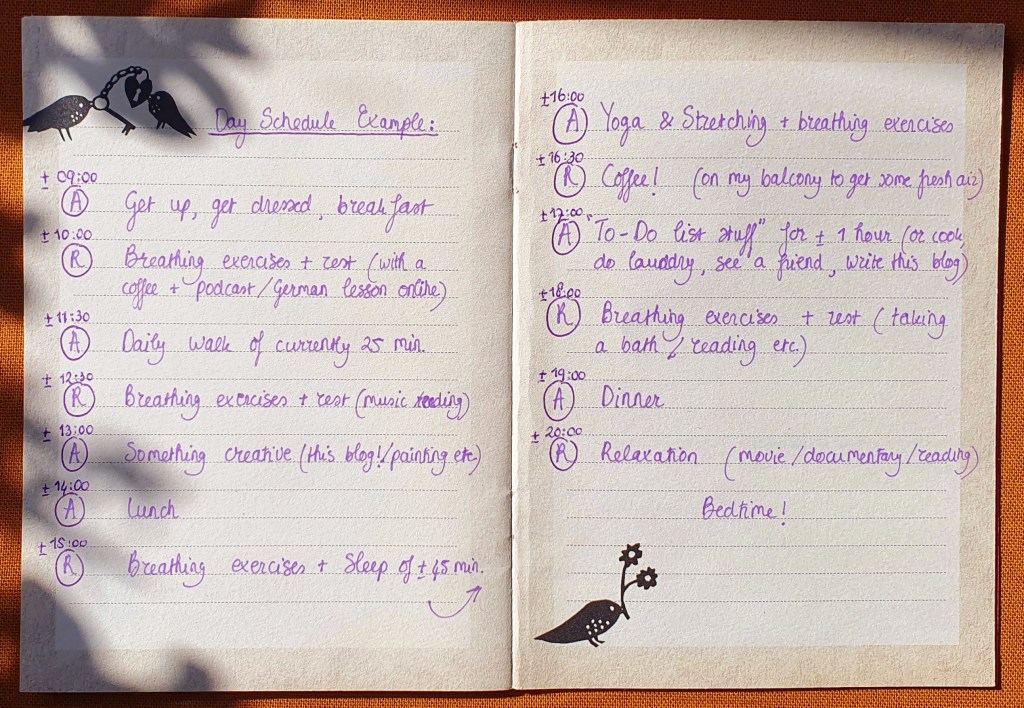
Below you will find an example of my personal day schedule (A = Activity, R = Rest):

I hope this post has convinced you of the benefits and will encourage you to design a schedule of your own. If you do so, here are my final important recommendations:

  1. Please take your time for drawing your schedule. It may seem easy, but depending on your energy levels, it might take a while. You might even need to take little breaks if you attempt to practice pacing.
  2. Don’t get discouraged if you have to adjust it a couple of times before it really works. You will notice soon enough that you need to puzzle and switch or swap a little.
  3. Please use your imagination and creativity to fill out your schedule according to your personality and taste. My day may seem extremely boring to you… Or maybe your living situation is very different from mine, that changes a lot in your schedule.
  4. Of course a day schedule is not fixed. I believe it works best if you use it with a flexible mind. More importantly, it demands a change from time to time, once you regain more strength and energy or in case of a relapse…

Hooray for today!

You can view all other posts here

Images by myself

Get informed!

A new virus, a new disease, causing mysterious long-term effects… Even doctors might not always be informed about every detail of the long COVID story, and internet has its limits too. Since I found it difficult to get the right information, I will provide my most valuable recources here for you:

1. For me the most valuable source of information is a series of videos, covering many important aspects of fatigue and pacing. After watching these videos, you will learn the basics of dealing with your fatigue.

Video 1 starts with an introduction to the video-series by Professor Rob Copeland, Director of the Advanced Wellbeing Research Centre (AWRC) at Sheffield Hallam University. This is followed by an introduction to fatigue by Clinical Professor of Ageing and Medicine Julia Newton.

Video 2 is by Associate Professor in Occupational Therapy Kate Hackett, explaining how to manage your energy during the day by firstly stabilising your situation and finding your new energy baseline, using an activity diary and the subsequent building phase with careful small increments of activity.

Video 3 is by Vincent Deary, Professor in Health Psychology, discussing how to deal with fatigue in terms of coping strategies, managing expectations of yourself and others and much more. There is this slide named “What the mind might tell you” that brought tears to my eyes, because it was so incredibly recognisable to me.

Video 4 is my personal favourite, by Victoria Strassheim, a Senior Physiotherapist. She explains the concept of deconditioning, exercise intolerance, exercise adaptation and how to engage in physical activities again.

Video 5 is a Question & Answer – Session by all the above specialists together. They discuss the frustrating non-linear recovery pattern of long COVID as well as other recurring topics.

P.S. As suggested by the authors, I strongly recommend to watch these videos separately and not all in one day.

P.S. 2: All credits for the video-series go to RICOVR Unit at Sheffield Hallam University and the CRESTA Fatigue Clinic – Newcastle Hospitals Foundation Trust. I am very grateful for your effort in sharing your experience and expertise with us.

2. I would like to share with you the most valuable podcast of all scientific podcasts! If you are interested in a weekly scientific update on SARS-CoV-2, then listen to the podcast series ‘Coronavirus-Update’ of NDR-Info.

Watch out: it’s a quite dense, but extremely informative and it beats the nonsense in so many quick and dirty media-resources. Only available in German! (also on Spotify btw).

To be continued…

You can view all other posts here

Image by Janko Ferlic on Pexels.com

Yoga & Stretching with Mr. Covid

I have a hate-love relationship with yoga: I like the physical exercise and relaxation that it brings, but I was never really drawn to the spiritual aura surrounding yoga. Especially in certain yoga studios in Berlin, buzzing Om sounds often made me hesitate to join a class. After months of coughing and immobilisation however, I learned that it is essential to awaken and carefully stretch your body in order to get back on your feet. For that purpose, yoga-like exercises are honestly a must!

The Om chants are not in my repertoire, but feel free to Om yourself…

Why bother? Because your (torso) muscles have most likely become stiff and weak due to excessive coughing and immobilisation. This is one of the main reasons for feeling breathless* during minimal physical activity. As a result of this breathlessness, it remains extremely difficult to get stronger and active again and you end up trapped in a breathlessness-inactivity-circle.

To help you escape this ‘breathlessness-inactivity circle’, I will share my daily stretching and yoga exercises with you. My advise is to contact your doctor or physiotherapist before joining if you have a known musculoskeletal disorder, or if anything feels not right during an exercise.

That being said, your biggest risk is merely to exhaust yourself depending on where you stand in your recovery. A few months ago, I was only able to perform exercise 1 and 7 before crashing weakened on the couch again. Now I am stronger and I manage all exercises on most days, but I have carefully and gradually built up this routine over time. Clearly, these exercises are all very easy for healthy individuals, but not for those dealing with Mr. Covid. I therefore propose the following rules upfront:

1. Please be gentle with your weak body
2. Please pay attention to the degree of difficulty of each exercise and skip the ones that are too challenging
3. Please don't forget to pace, and assess your energy levels before starting
4. Put on some music to make things a lot more pleasant

Now let’s start!

Exercise 1 (LIGHT): to relieve tension and open your chest

Stand on your feet and as you inhale, elongate through your torso and extend your arms up (left figure). Stay for 1-2 breaths. On the next exhale, slowly let your back drop down, as far as remains comfortable for your hamstrings (right figure).

Stay for 1-2 breaths. As you exhale, lift up your head and look to the front. Get up slowly on the following exhale.

Exercise 2 (LIGHT): to open and stretch your intercostal muscles and diaphragm

Step forward with your right foot and turn your left foot 90 degrees facing the left wall, your head facing the front (left figure). Stay for 1-2 breaths. On the next exhale, put your right forearm on your right knee and look towards the ceiling. Lift your left arm towards the ceiling (right figure). Engage your abdomen if you lose your balance!

If you are stronger, you could put your right hand on the floor.

Exercise 3 (LIGHT-MODERATE): to stretch your hips and bottom, mobilise your spine and intercostal muscles

From the last position in exercise 2, turn to the right facing the front as in the left figure. Stay for 1-2 breaths.

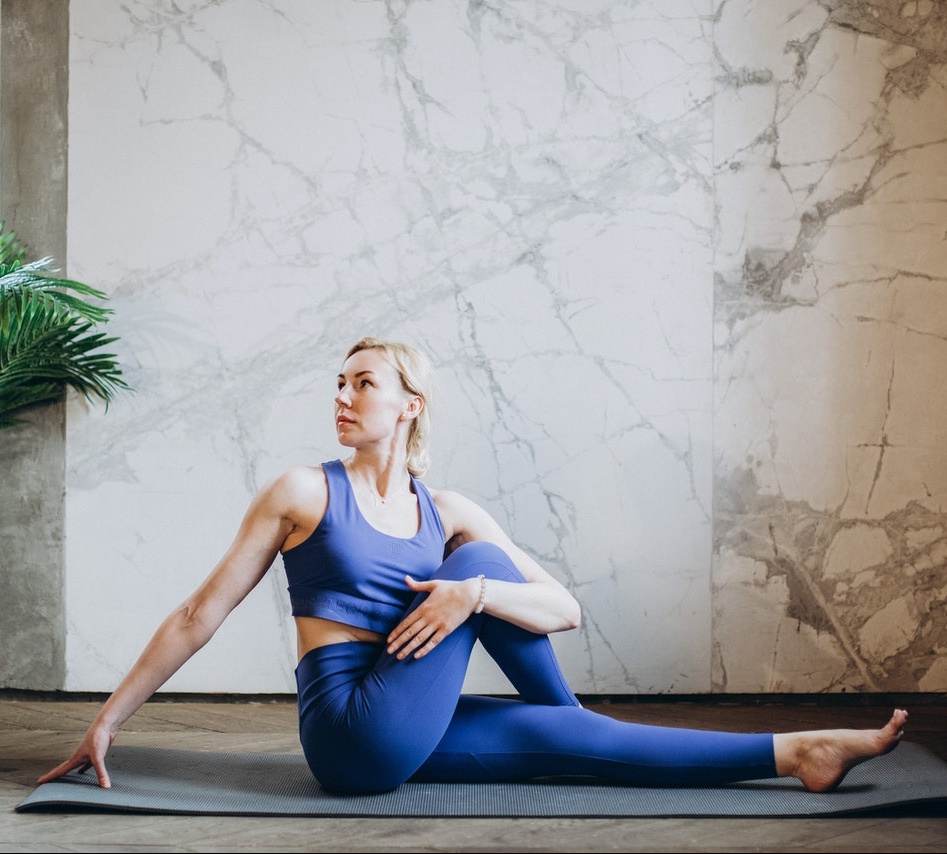
Put your hands on the floor, lean down on your right hip and turn 180 degrees on the floor facing the opposite direction. Keep your left leg stretched while crossing your right leg over your left knee (right figure). On the next exhale, turn your back by looking to the right. Don’t forget to stretch your upper body.

I switch sides here and do exercises 1-3 in reverse order with my left side before moving to the next exercise.

Exercise 4 (LIGHT-MODERATE): to relax your neck muscles and lower back, stretch your hips and chest

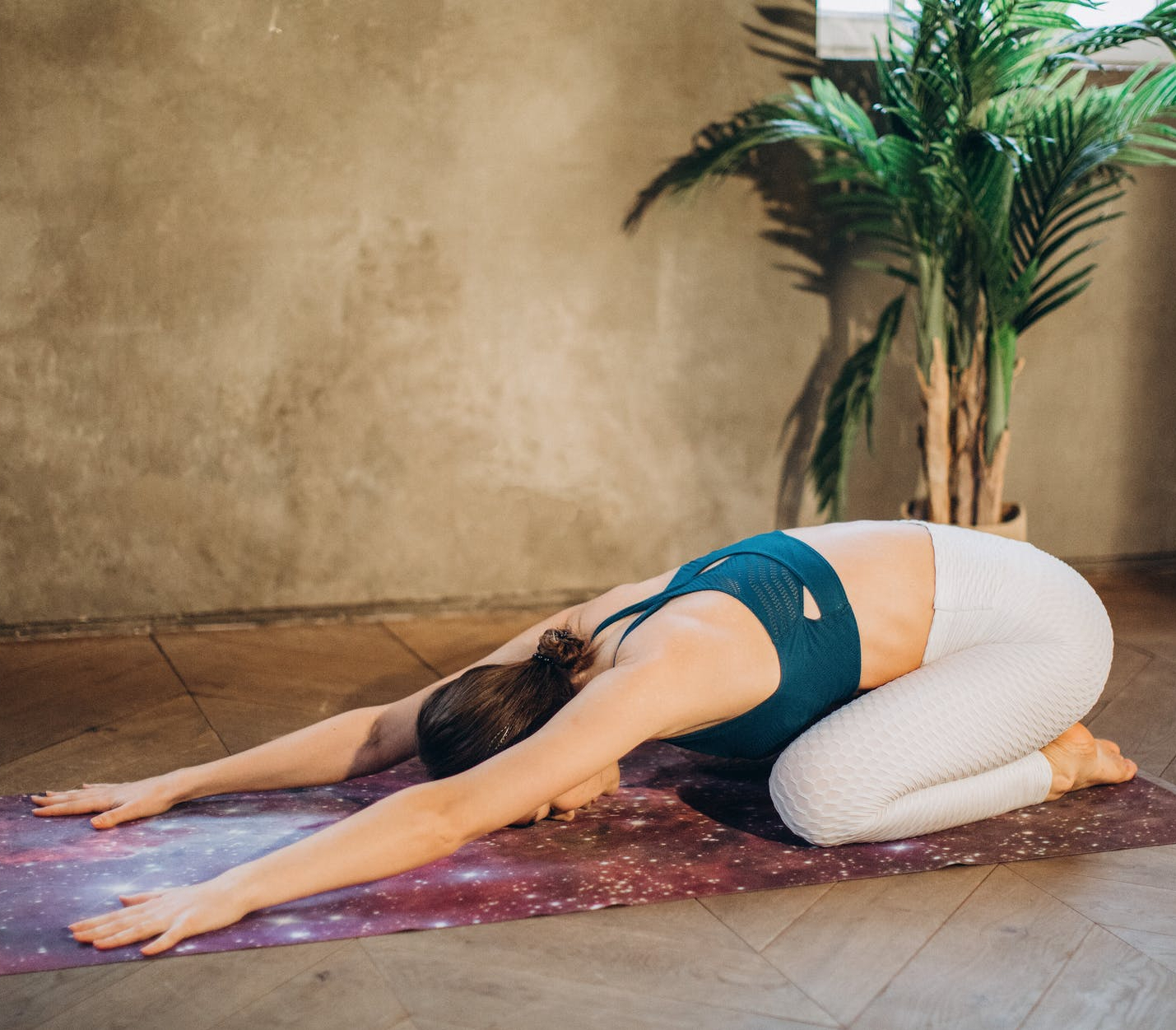
Start in a kneeling position with your toes tucked under, lower your bottom towards your heels and extend your upper body to stretch your back (left figure). Stay for 1-2 breaths. Move your weight on your hands and watch the ceiling as you exhale (right figure). Try to open your chest and straighten your neck.

If possible, combine with exercise 5.

Exercise 5 (HEAVY): to loosen your lower back, straighten and strengthen your upper back

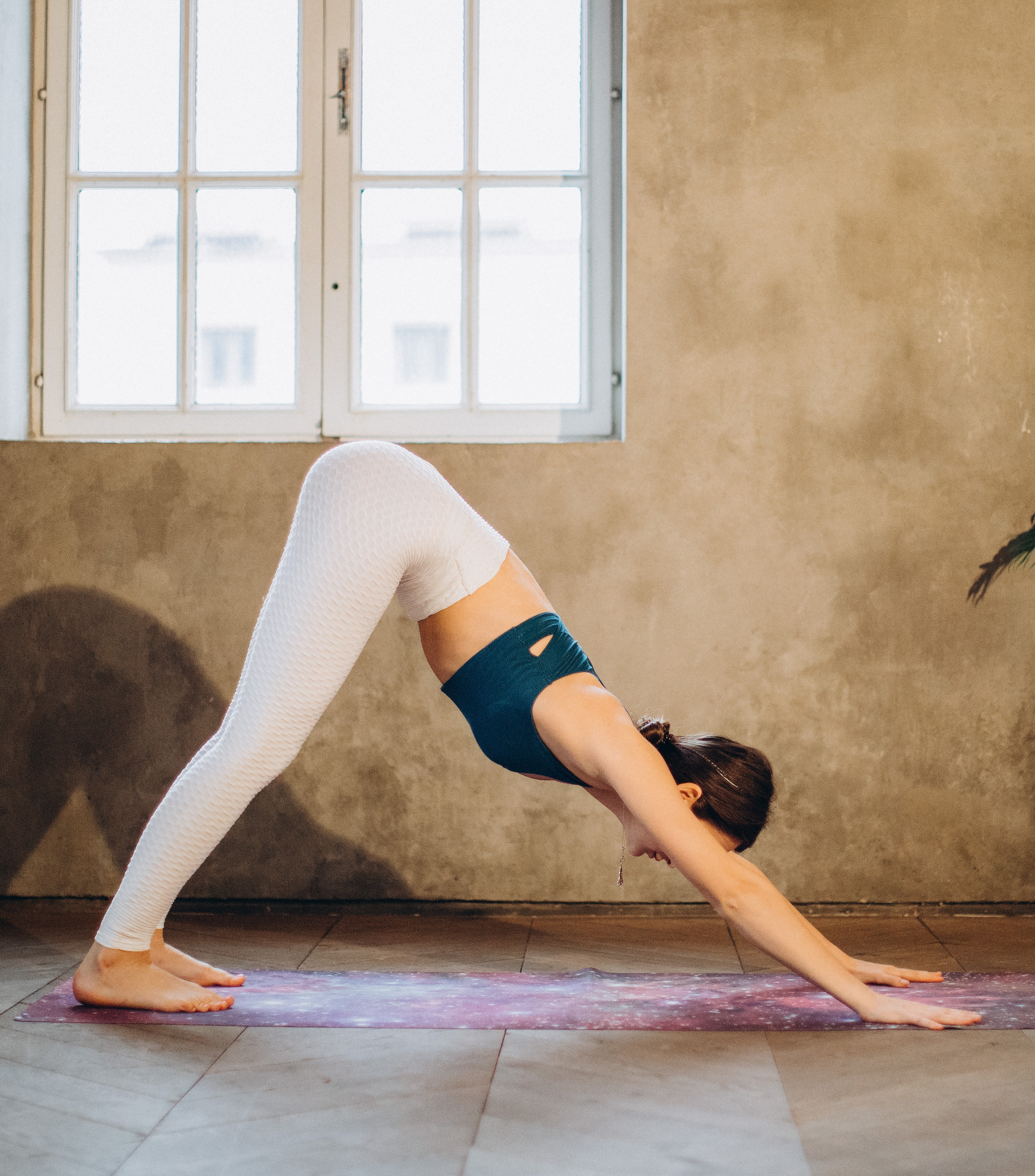
I could never have managed this ‘downward facing dog’ position a few weeks ago. I still totally cheat to get in this position from the endpoint of the last exercise by placing my knees on the floor before lifting my bottom as I exhale (left figure). Stay for 1-2 breaths. Most important: extend your upper back!

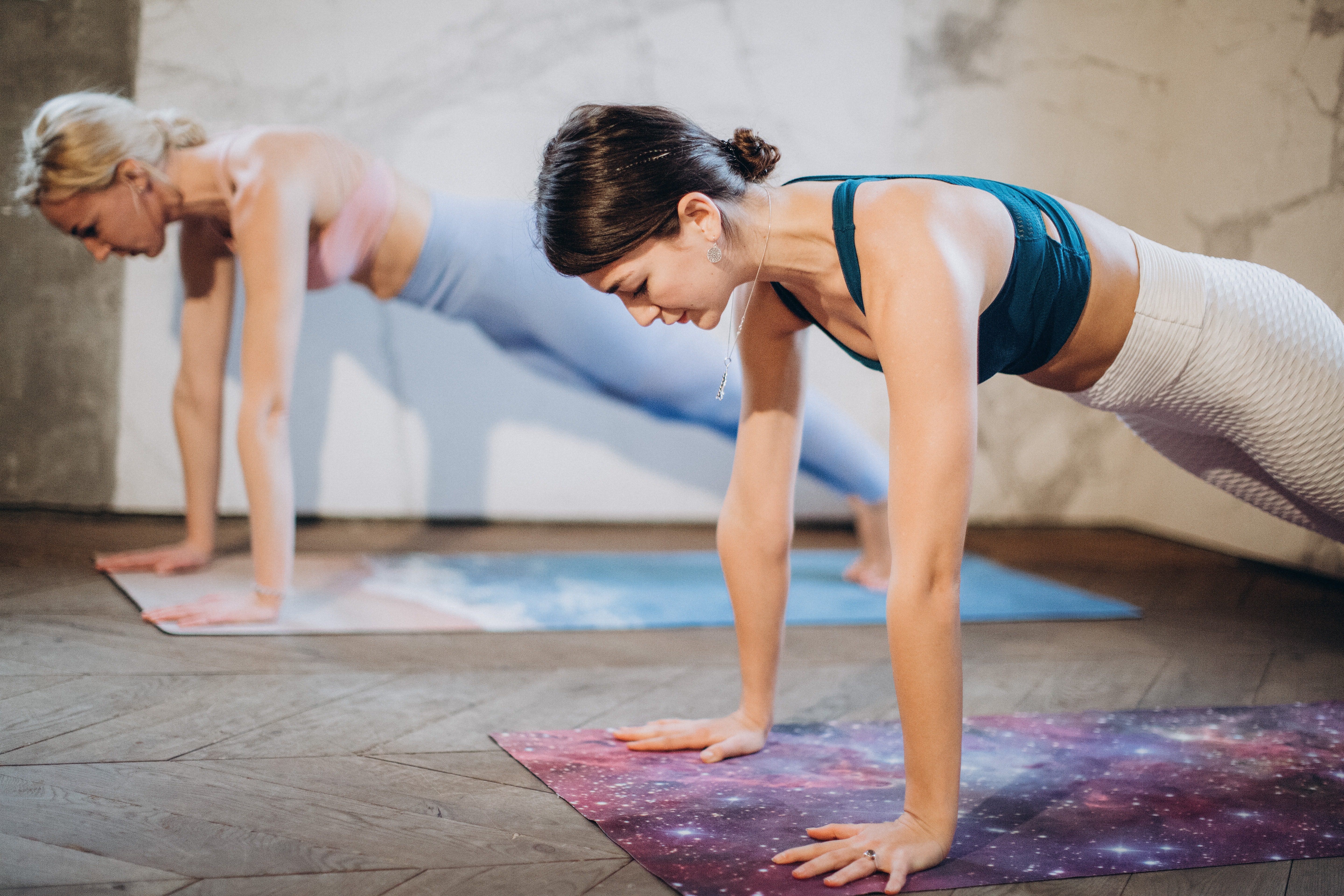
On the next exhale, replace your weight forward and feet backwards to form the plank (right figure). Straighten your back.

Exercise 6 (LIGHT-MODERATE): to relieve muscles of your chest and upper back

From the plank, place your knees down (left figure). As you exhale, extend your left arm to the ceiling and open your chest by facing the ceiling (right figure). On the next exhale, lower your left arm, crossing under your chest and reaching towards the right wall (no picture). If you want to increase this stretch, you could lower your head to the floor facing right (right figure).

Exercise 7 (LIGHT): to loosen the back of your legs

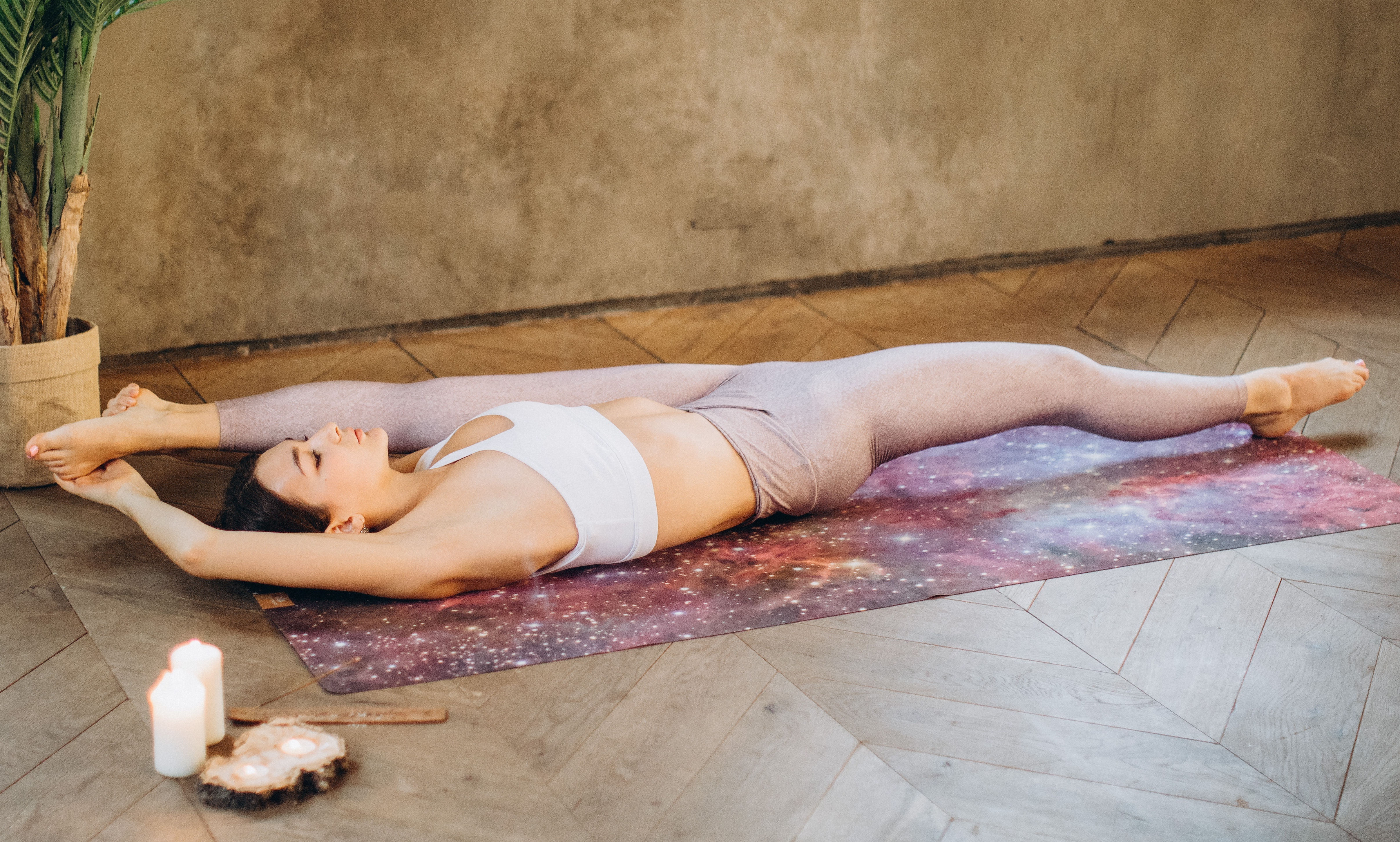
Now we arrive at a more relaxing part: lie down on your back on a blanket or yoga mat. Start by pulling your left knee to your chest, stay for 1-2 breaths and then straighten your left leg to stretch your hamstrings. If possible, turn your leg to the left as you exhale (right figure).

After a few breaths, bring your leg down into the starting position and notice the funny sensation that your left leg feels longer then your right! I still love this after a thousend times… Repeat on the other side.

Exercise 8 (LIGHT): to loosen your diaphragm and lower back, relax your breathing

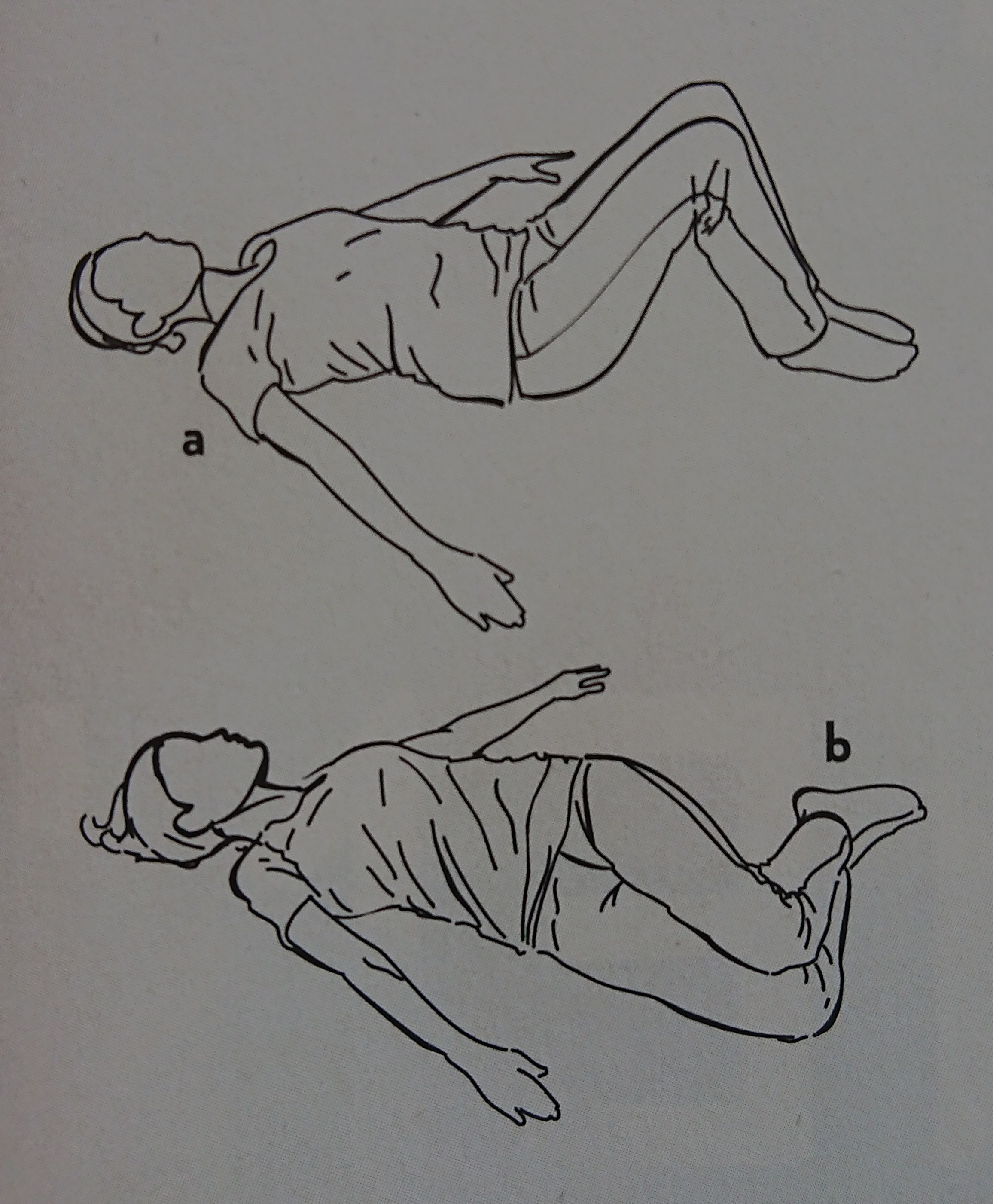
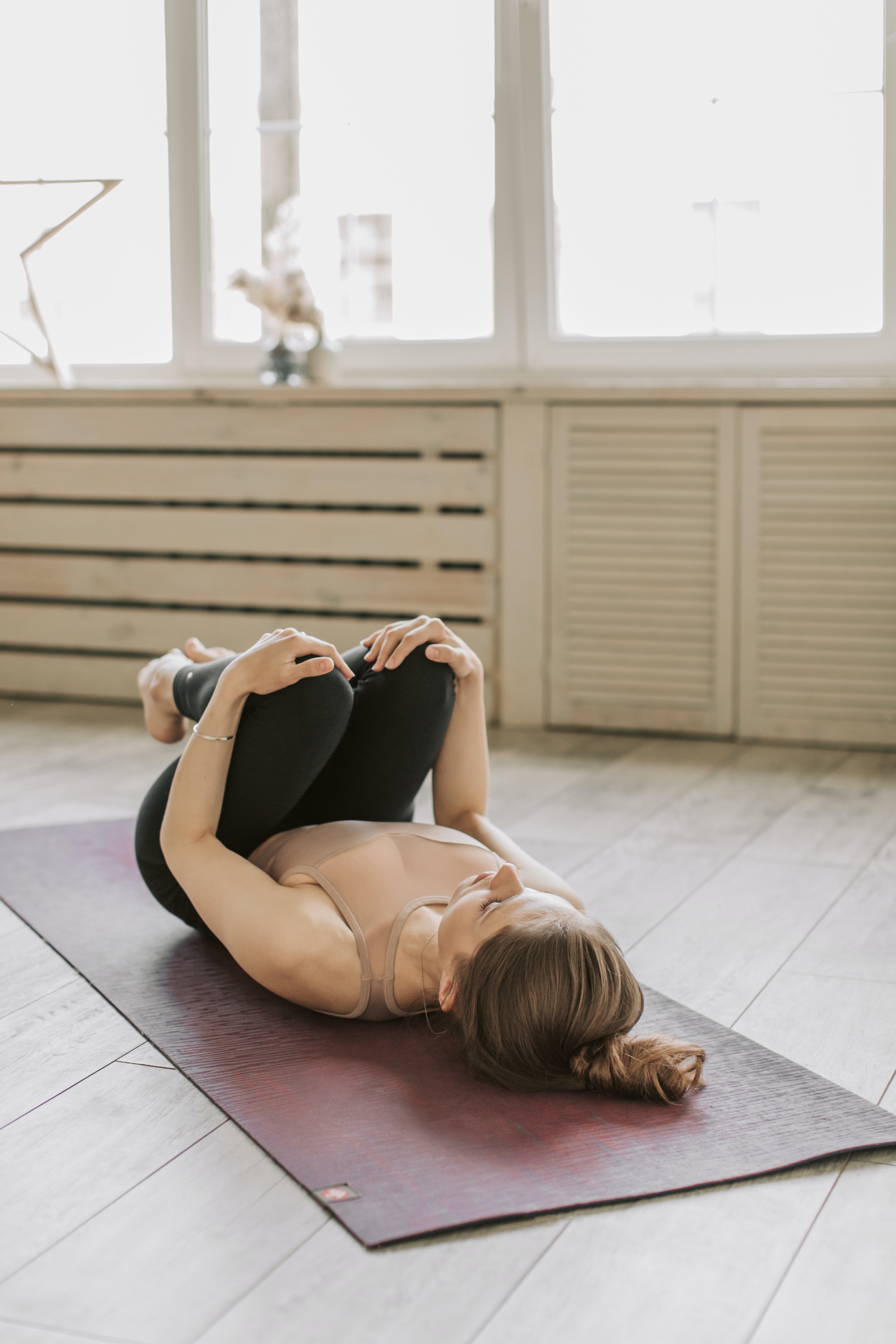
While still laying down, pull your knees up with your feet close to your bottom and inhale. Let your knees drop to the right as you exhale (left figure). Stay for a few deep breaths and bring your knees back on the next exhale. Switch sides.

Back in the starting position, pull your knees up to your chest and massage your lower back and pelvis musculature by circling your pelvis while holding your knees (figure in the middle). This may feel a little uncomfortable if you have tense muscles, but you’ll love it after a few days.

I also do some easy abdominal exercises, for example cycling in the air, or lifting my pelvis with my feet close to my bottom (right figure).

Exercise 9 (LIGHT): to relieve and stretch tense intercostal and neck muscles

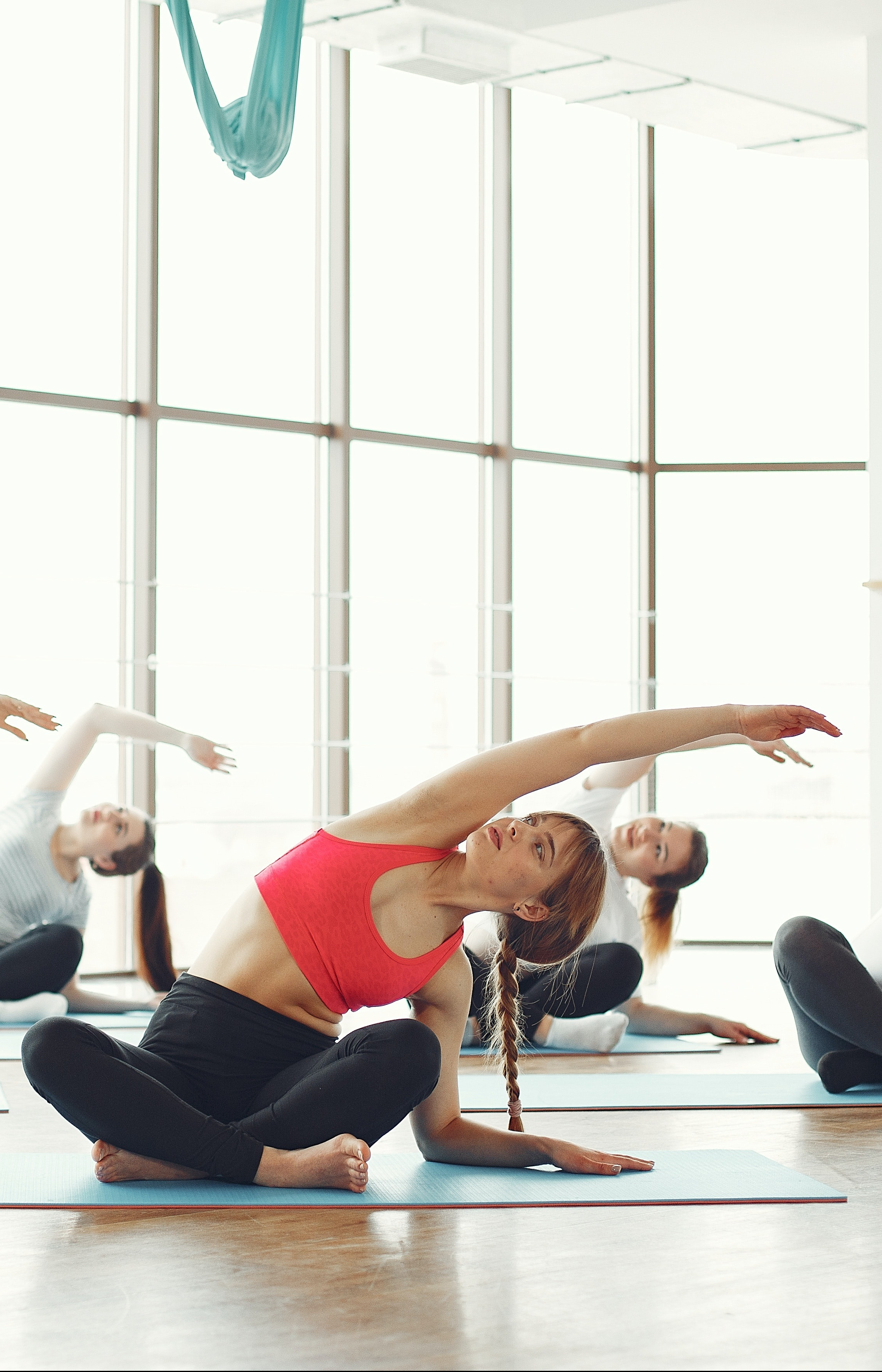
Sit down as demonstrated in the picture (I actually prefer to sit on my knees), inhale, and extend your left arm above your head (keep your shoulders low). As you exhale, stretch over to the right side and face the ceiling. Return to the starting position on the next exhale. Switch sides.

Then place your right hand on your left ear without pressure and let your head gently drop to the right side to stretch your neck. Switch sides.

Exercise 10 (LIGHT-MODERATE): to stretch your quadriceps and improve your balance

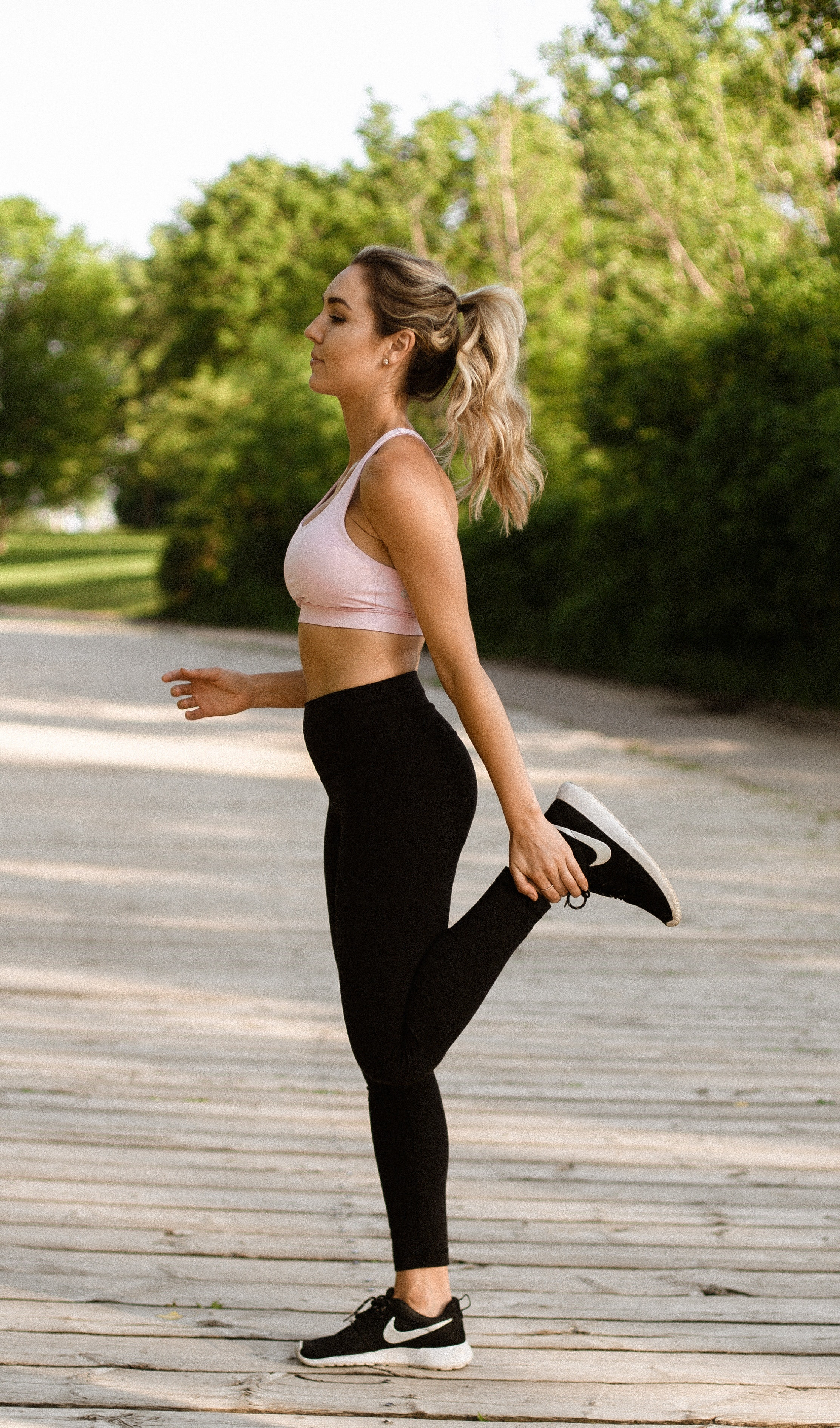
Gently get up and stretch your quadriceps by standing on one leg and taking your other heel to your bottom. Drop your pelvis and straighten your lower back (left figure).

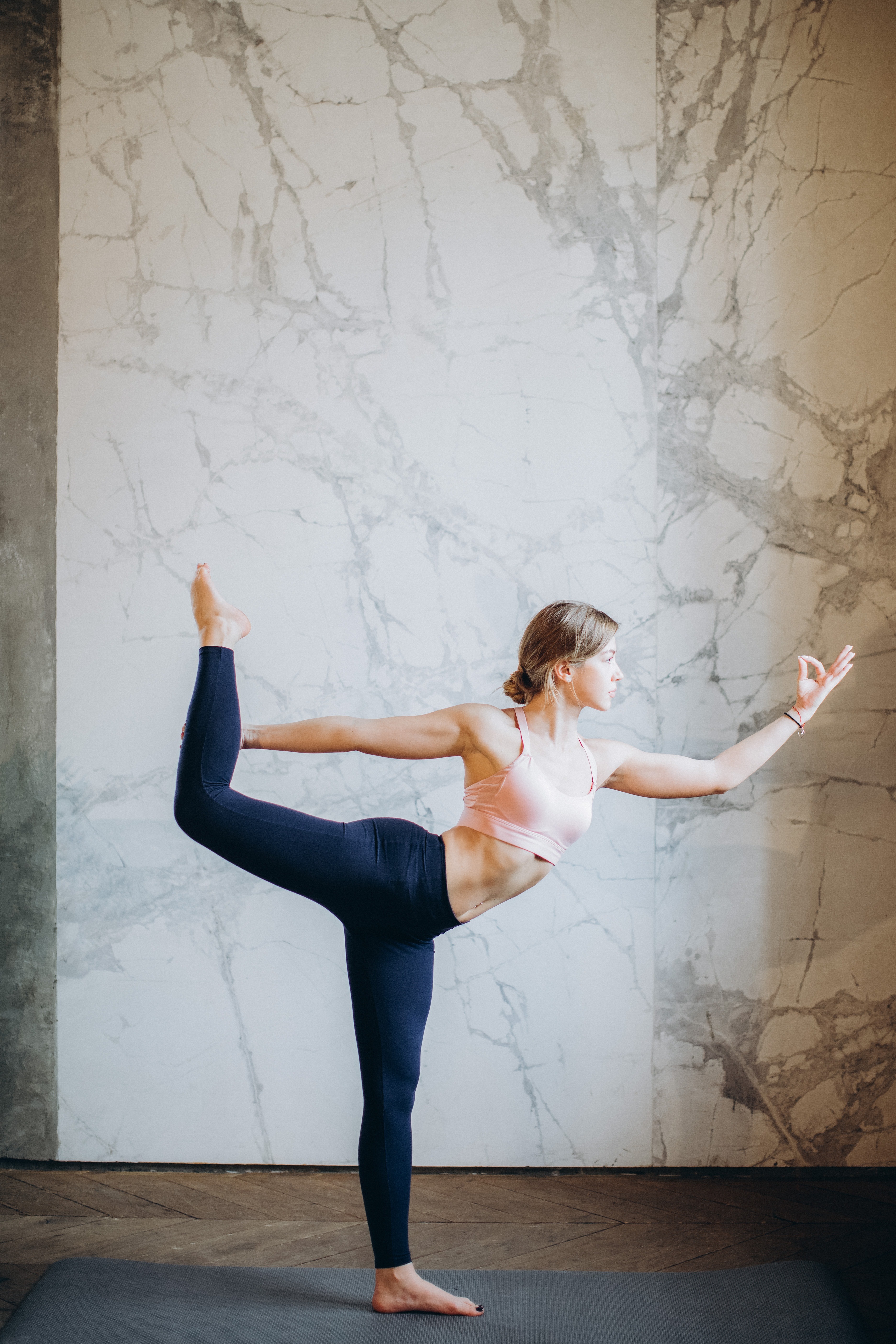
On the next exhale, you could test your balance by gently lifting your leg behind you (right figure). Engage your abdomen and use a fixed focus point if you tend to lose balance. Switch sides.

Did you know that:

You can use yoga to improve your breathing by releasing your diaphragm and strengtening the muscles of your chest. For this, try to breathe deeply and regularly, and more into your abdomen and lower back then superficially into your chest.

* breathlessness may be caused by many potential underlying conditions that you need to exclude with your doctor upfront.

You can view all other posts here

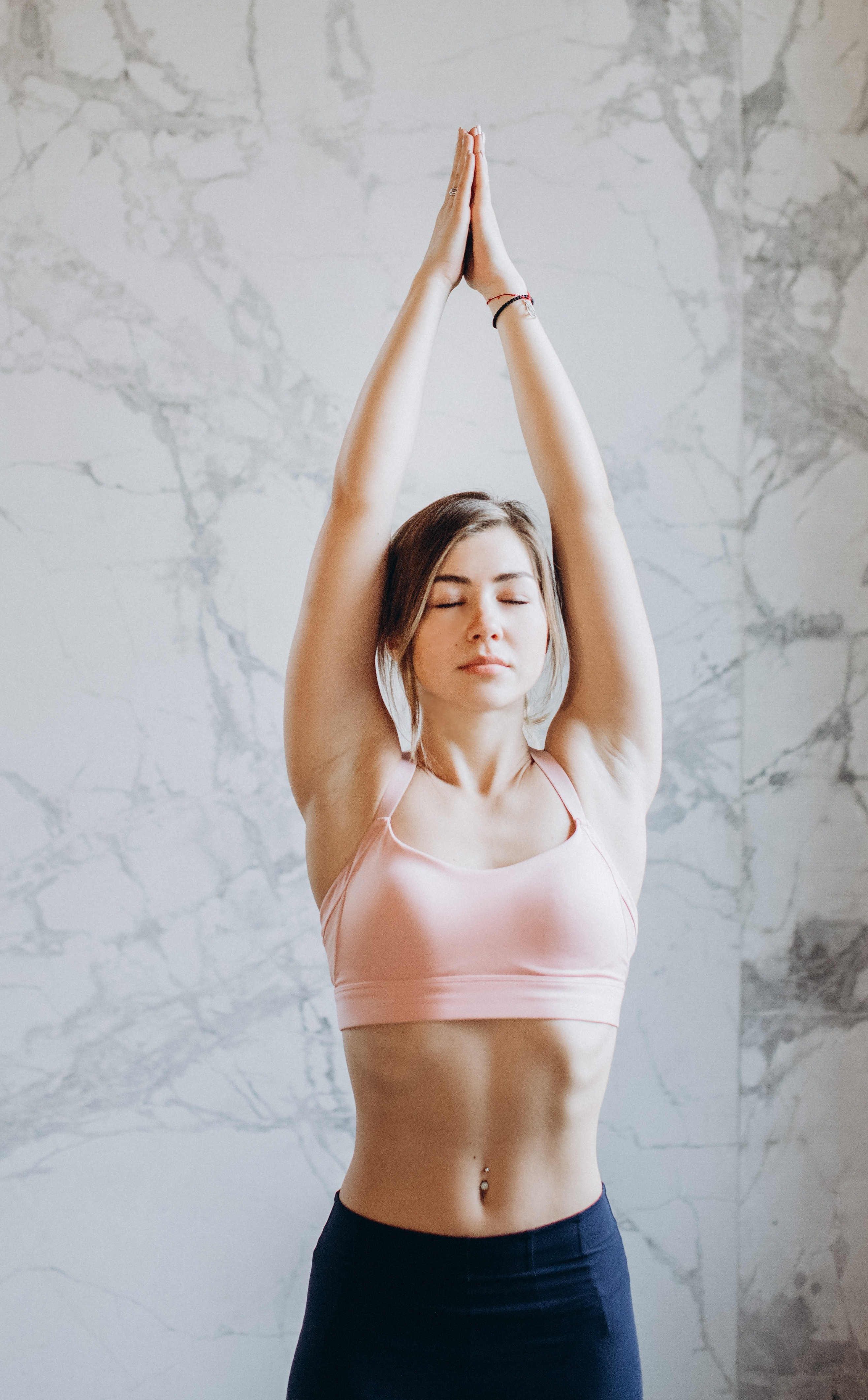
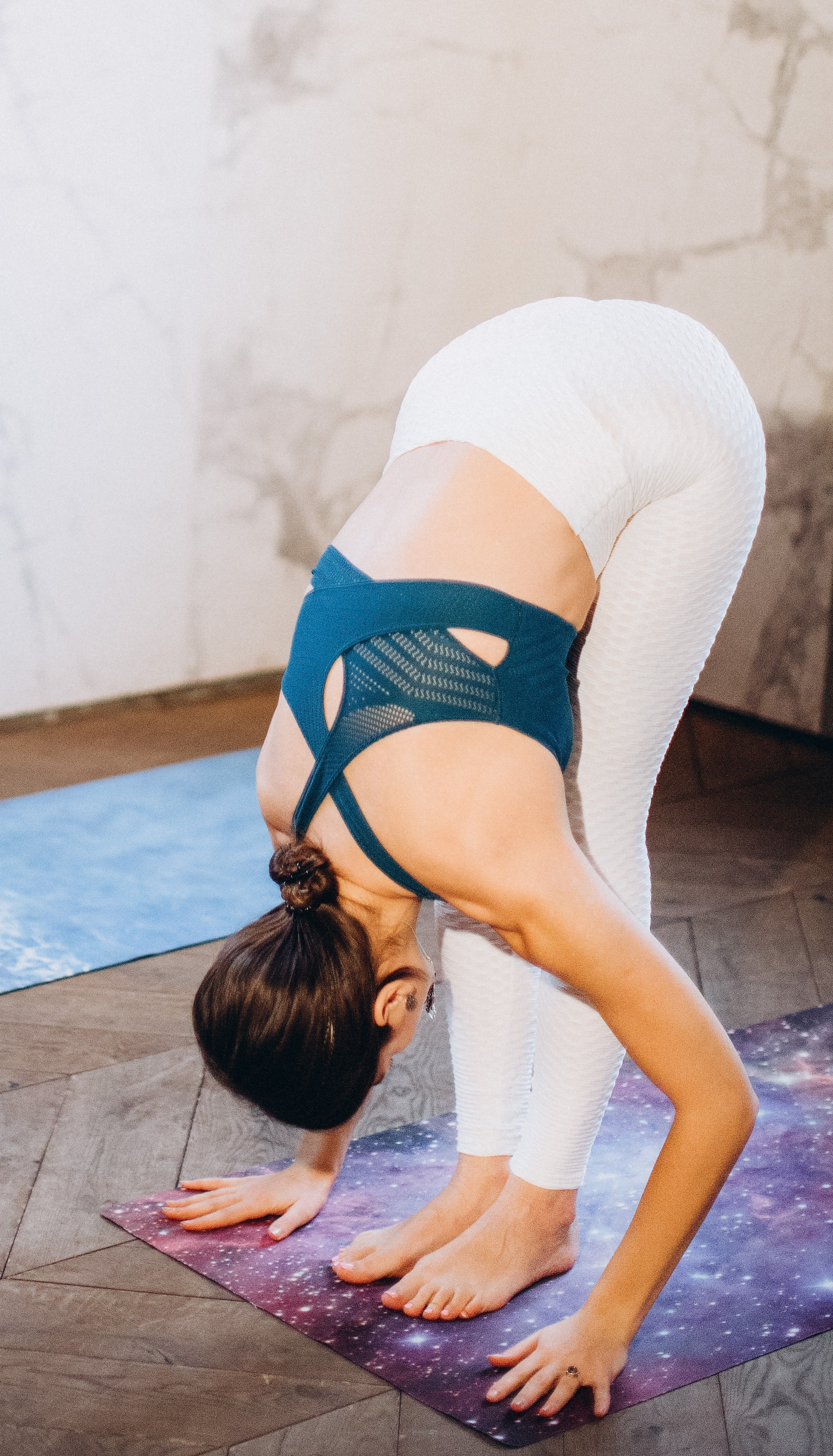
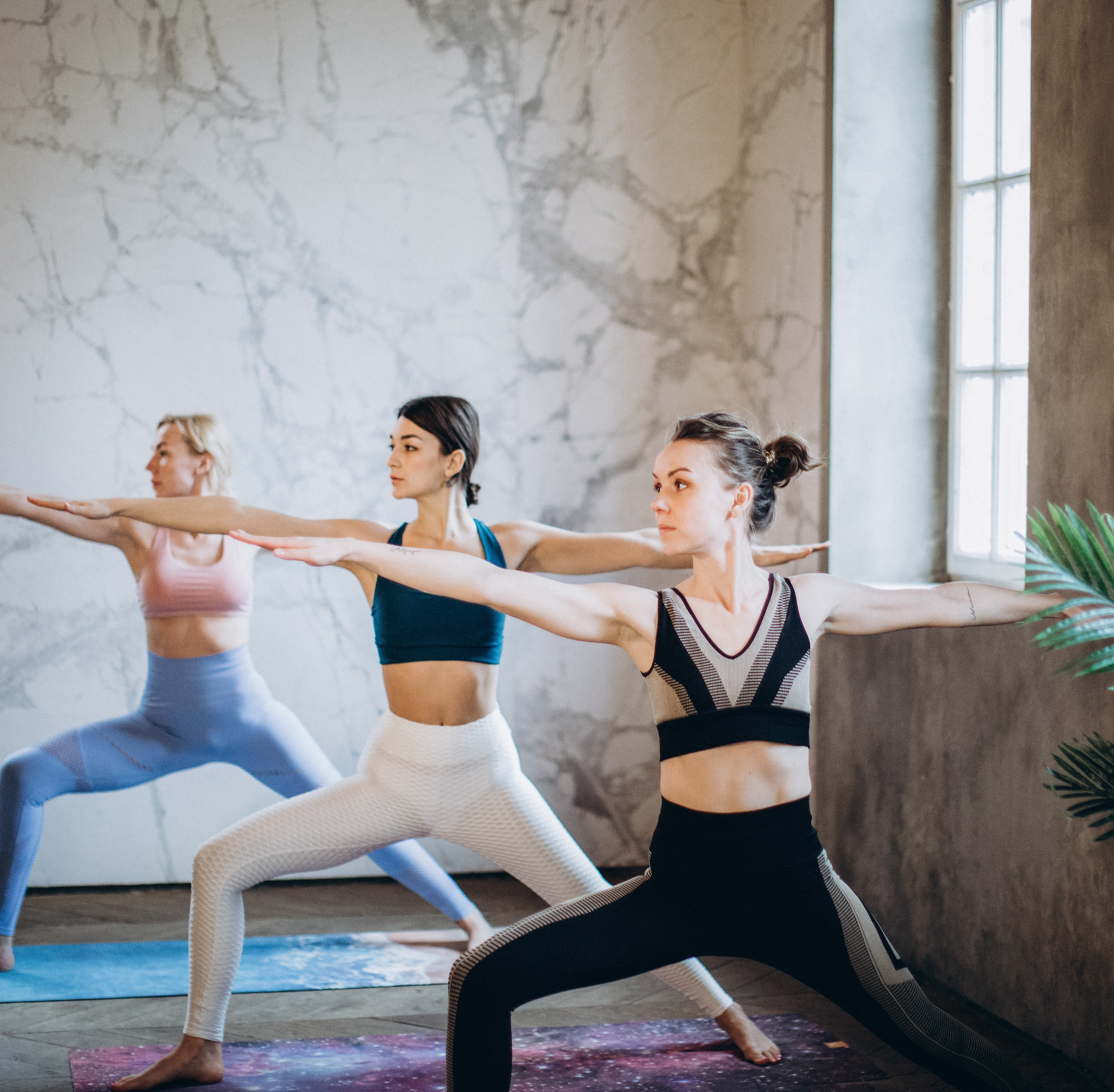
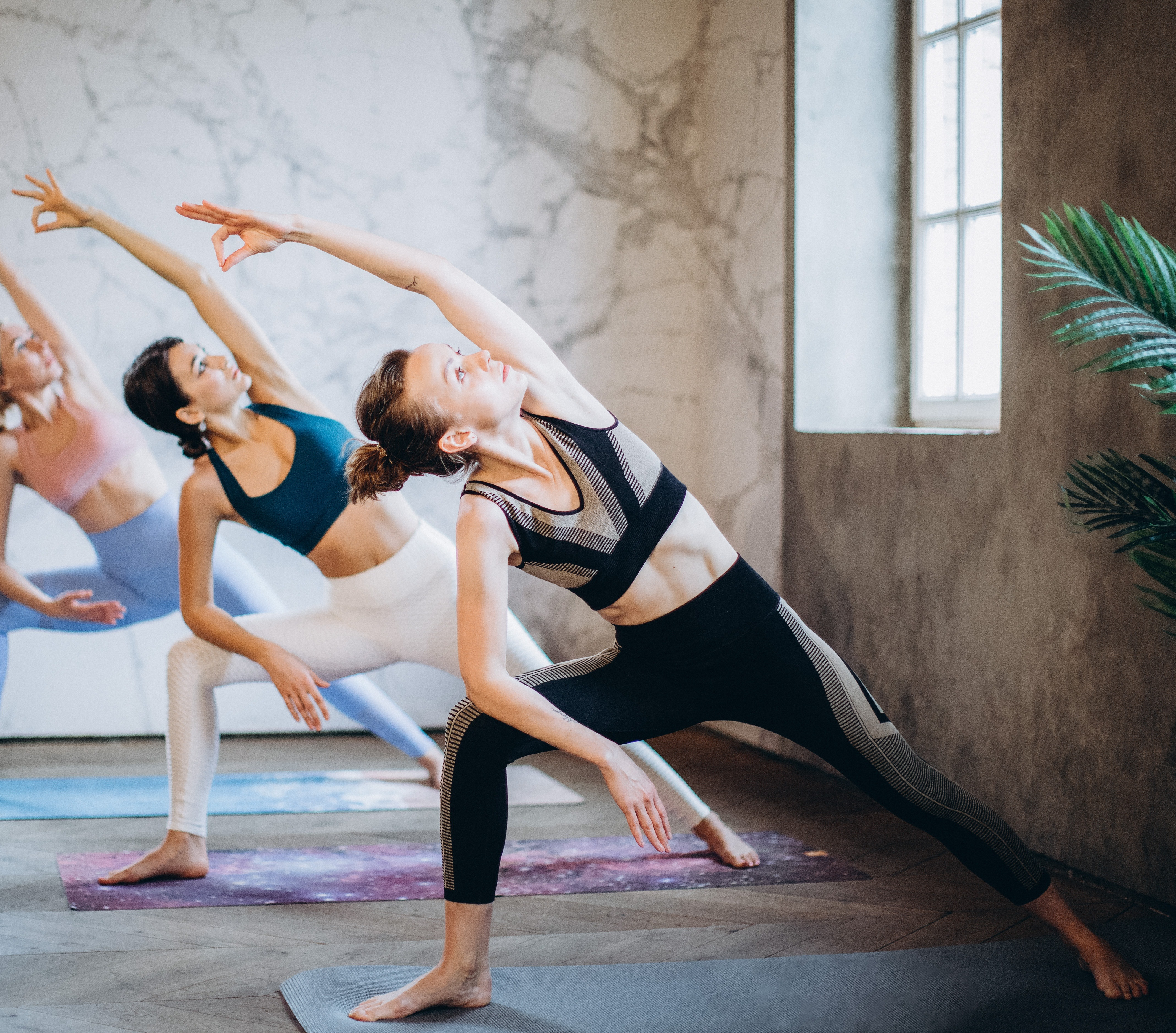
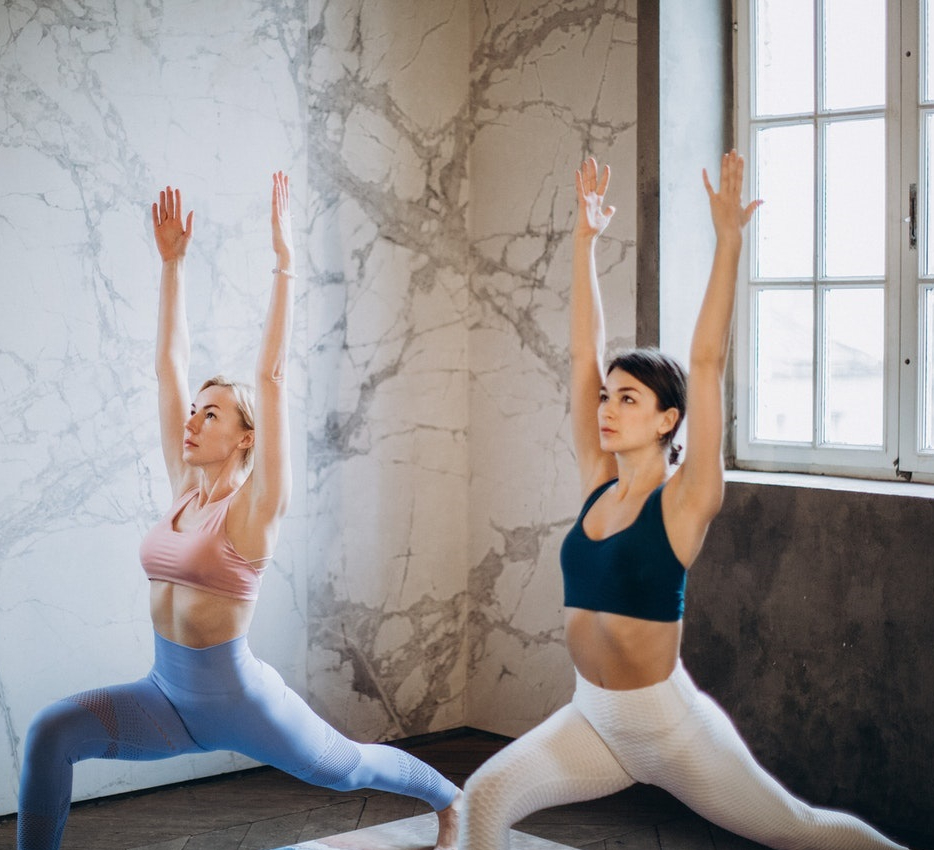
Images by Pexels